Enhanced ACT Math Guide 2026/2027: Format, Topics & Strategy
A complete guide to Enhanced ACT Math for 2026–2027, including the 45-question format, official math categories, worked examples, calculator and Desmos strategy, pacing, formulas, and an effective study system.
If your ACT Math preparation still assumes 60 questions in 60 minutes, you are studying for the old test.
The current Enhanced ACT Math section gives you 45 questions in 50 minutes. There are now four answer choices instead of five, the content balance has shifted toward higher-level math, and students taking the digital ACT have access to a built-in Desmos graphing calculator.
The mathematics itself still comes from skills students typically learn through the beginning of grade 12, but the way you should prepare has changed.
You need to know the content.
You also need to recognize problems quickly, choose efficient methods, use your calculator intelligently, and avoid spending too much time on one difficult question.
This guide explains the complete Enhanced ACT Math format for 2026–2027, the official topic categories, the most important strategies, original worked examples, calculator decisions, pacing, and a practical way to study.
Relevant TEM pages
Enhanced ACT Math Format at a Glance
| Feature | Enhanced ACT Math |
|---|---|
| Total questions | 45 |
| Scored questions | 41 |
| Embedded field-test questions | 4 |
| Total time | 50 minutes |
| Average time per question | About 67 seconds |
| Answer choices | 4 |
| Calculator | Allowed throughout Math |
| Digital calculator | Built-in Desmos available |
| Formula sheet | Not provided |
| Math score | 1–36 |
The biggest visible changes from the old ACT are straightforward:
Old ACT Math: 60 questions in 60 minutes
Enhanced ACT Math: 45 questions in 50 minutes
You now have slightly more time per question.
But that does not mean the section should feel relaxed.
You still have only about:
50 ÷ 45 ≈ 1.11 minutes
or roughly:
67 seconds per question
The better way to think about that number is not:
I must spend exactly 67 seconds on every problem.
Instead:
TEM Strategy
Easy questions should save you time that you can spend on difficult questions later.
Some questions may take 20–30 seconds.
Others may require two minutes.
Good pacing means distributing your time intelligently.
41 Questions Count Toward Your Score
The Enhanced ACT Math section contains 45 total questions, but only 41 are operational scored questions.
The remaining four are embedded field-test questions used by ACT for future test development.
You are not told which four are unscored.
That means there is only one useful strategy:
Treat every question as if it counts.
Trying to identify field-test questions during the exam is pointless and can hurt your performance.
A question that feels strange or unusually difficult is not automatically experimental.
Solve what you can and move forward.
What Math Is on the Enhanced ACT?
ACT divides Mathematics into two major reporting categories:
Preparing for Higher Math — 80%
and:
Integrating Essential Skills — 20%
There is also a Modeling reporting category that appears throughout the test rather than existing as a separate group of questions.
Preparing for Higher Math is divided into five areas:
| Area | Approx. Share of Scored Math |
|---|---|
| Number & Quantity | 10–12% |
| Algebra | 17–20% |
| Functions | 17–20% |
| Geometry | 17–20% |
| Statistics & Probability | 12–15% |
| Integrating Essential Skills | 20% |
This content balance matters.
On the older ACT, Preparing for Higher Math represented a smaller portion of the section.
On the Enhanced ACT, it now makes up roughly 80% of scored Math content.
That means your preparation should not focus only on basic arithmetic and quick tricks.
Algebra, functions, geometry, and statistical reasoning deserve serious attention.
Number & Quantity
Number & Quantity includes skills involving different number systems and numerical representations.
You should be comfortable with concepts such as:
-
integers
-
fractions and decimals
-
rational and irrational numbers
-
exponents
-
radicals
-
complex numbers
-
scientific notation
-
vectors
-
matrices
The important skill is often recognizing how numbers behave rather than performing long arithmetic.
Worked Example: Exponents
If:
2³ × 2⁵ = 2ⁿ
what is n?
When multiplying powers with the same base, add the exponents:
2³ × 2⁵ = 2³⁺⁵
So:
n = 8
A common mistake would be:
3 × 5 = 15
but exponents follow their own rules.
Remember
Same base multiplied → add exponents.
Power raised to a power → multiply exponents.
For example:
(x³)⁴ = x¹²
These rules should become automatic because spending 30 seconds reconstructing exponent laws wastes valuable time.
Algebra
Algebra is one of the largest content areas on ACT Math.
You may encounter:
-
linear equations
-
inequalities
-
systems of equations
-
polynomial expressions
-
factoring
-
radical equations
-
exponential equations
-
absolute value
-
algebraic modeling
ACT Algebra questions often look complicated because of the way information is presented.
The underlying mathematics may actually be simple.
Worked Example: Build the Equation First
A gym charges a one-time registration fee of $35 and then $24 per month.
If Marcus paid a total of $179, how many months did he pay for?
A. 5
B. 6
C. 7
D. 8
Translate the situation into an equation.
Let m represent the number of months.
35 + 24m = 179
Subtract 35:
24m = 144
Divide by 24:
m = 6
The answer is:
B. 6
| Option | Decision | Why |
|---|---|---|
| A. 5 | Reject | Five months plus the registration fee costs only $155 |
| B. 6 | Keep | 35 + 24(6) = 179 |
| C. 7 | Reject | Gives $203 |
| D. 8 | Reject | Gives $227 |
The most important step was not solving the equation.
It was creating the correct equation.
TEM Strategy
In ACT word problems, translate before you calculate.
Ask what each number represents before touching the calculator.
Systems of Equations
A system represents two or more conditions that must be true simultaneously.
Suppose:
x + y = 11
and:
x − y = 3
Add the equations:
x + y + x - y = 11 + 3
therefore:
2x = 14
So:
x = 7
Then:
y = 4
The solution is:
(7, 4)
You could also solve this graphically.
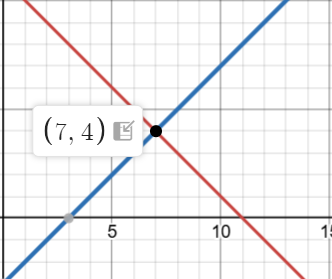
Which method is better?
Here, elimination takes only a few seconds.
Graphing would probably be slower.
That is an important ACT Math principle:
Use technology when it saves time—not simply because it exists.
Functions
Functions are another major portion of Enhanced ACT Math.
You should understand:
-
function notation
-
domain and range
-
evaluating functions
-
graphs
-
transformations
-
linear functions
-
quadratic functions
-
polynomial functions
-
radical functions
-
piecewise functions
-
exponential functions
-
logarithmic functions
Do not treat function notation as complicated decoration.
If:
f(x) = 2x² − 5
then:
f(3)
means substitute 3 for x.
f(3) = 2(3²) − 5
= 18 − 5
= 13
Worked Example: Function Transformation
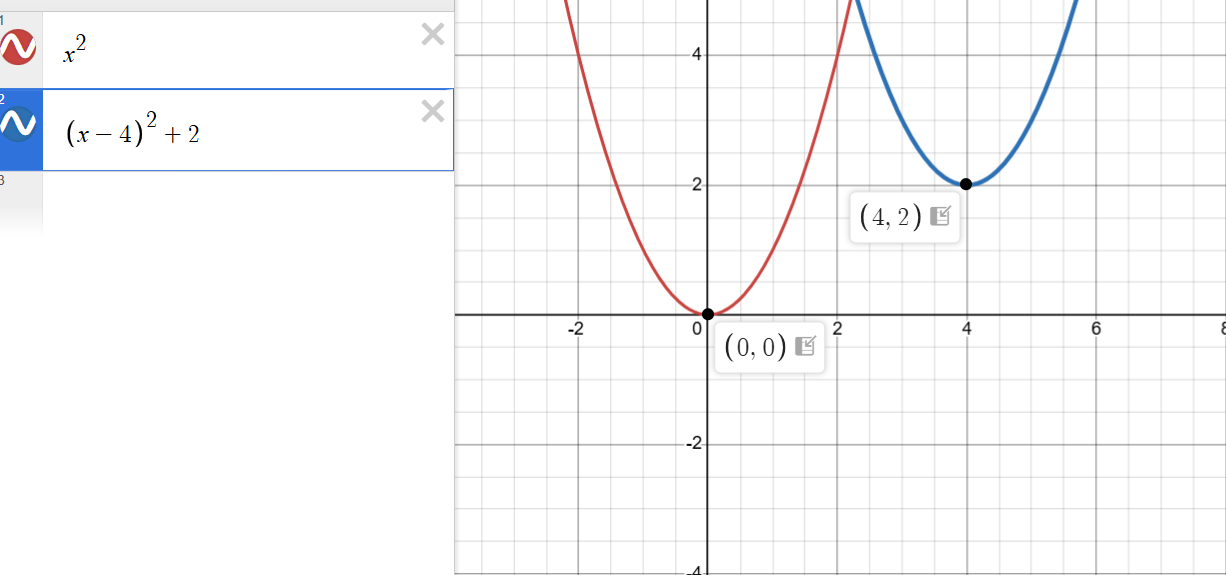
Suppose:
f(x) = x²
and:
g(x) = (x − 4)² + 2
How is the graph of g related to the graph of f?
The expression:
x − 4
moves the graph 4 units to the right.
The:
+2
moves it 2 units upward.
So g is the same basic parabola shifted:
4 right and 2 up
Common Trap
Horizontal transformations often feel backward.
Inside the function:
x − 4 → right 4
x + 4 → left 4
Understanding the graph is usually more useful than memorizing disconnected transformation rules.
Linear vs. Exponential Relationships
This distinction appears frequently in standardized math.
Consider:
A = 500 + 40t
The value increases by the same amount every period.
That is linear growth.
Now consider:
B = 500(1.08)ᵗ
The value increases by the same percentage every period.
That is exponential growth.
The factor:
1.08
means an increase of:
8%
A decrease of 8% would use:
0.92
A common mistake is treating percentage growth as simple addition.
Geometry
Geometry represents another major content category.
ACT can test:
-
triangles
-
circles
-
polygons
-
angle relationships
-
congruence
-
similarity
-
coordinate geometry
-
area
-
surface area
-
volume
-
right-triangle trigonometry
-
conic sections
One important difference from the Digital SAT is that ACT Math does not provide a general formula reference sheet.
ACT assumes knowledge of common formulas.
That means you should know the ones you use regularly.
Worked Example: Similar Triangles
Triangle ABC is similar to triangle DEF.
A side of length 8 in triangle ABC corresponds to a side of length 20 in triangle DEF.
Another side of triangle ABC has length 14.
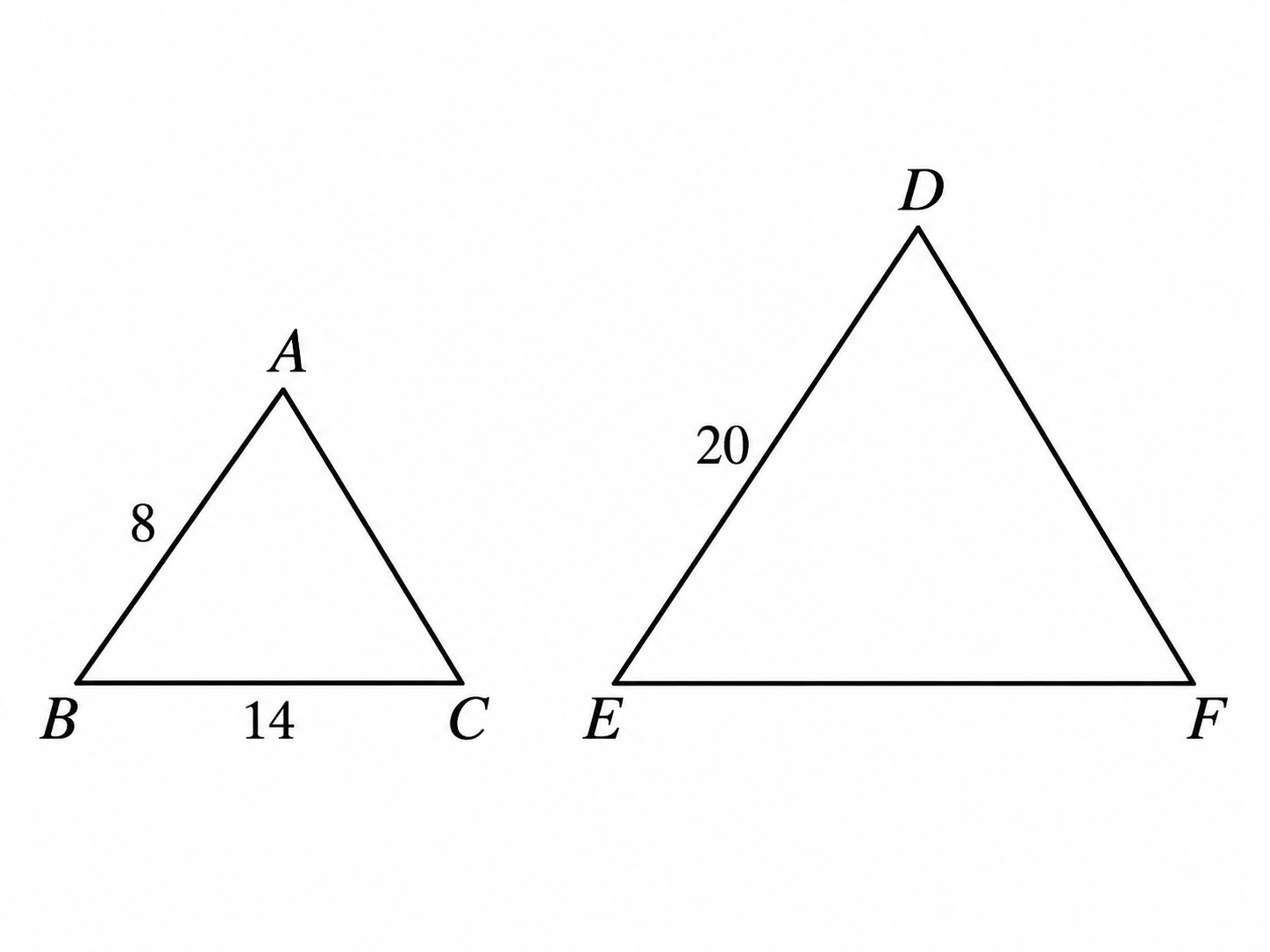
What is the corresponding side in triangle DEF?
Find the scale factor:
20 ÷ 8 = 2.5
Now multiply:
14 × 2.5 = 35
The answer is:
35
Common Trap
Similar figures use multiplication by a common scale factor.
Do not add the same amount to every side.
Right-Triangle Trigonometry
You should know:
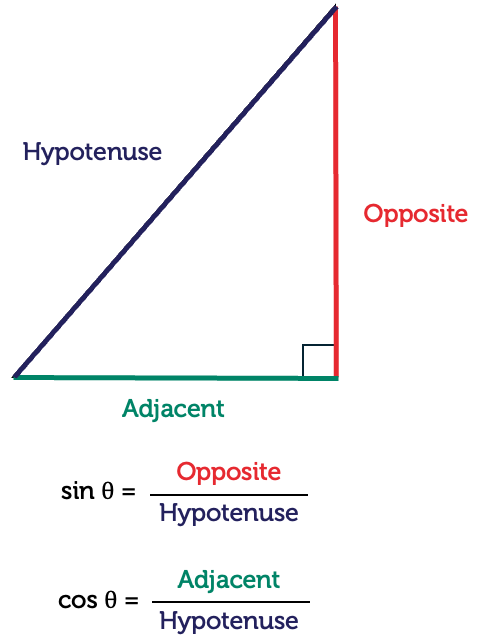
sin θ = opposite / hypotenuse
cos θ = adjacent / hypotenuse
tan θ = opposite / adjacent
Suppose a right triangle has:
opposite = 6
adjacent = 8
hypotenuse = 10
Then:
sin θ = 6/10 = 3/5
cos θ = 8/10 = 4/5
tan θ = 6/8 = 3/4
The hard part is often not remembering SOH-CAH-TOA.
It is correctly identifying which side is opposite and which is adjacent relative to the angle you are using.
The hypotenuse is always opposite the 90° angle.
Know Your Core Geometry Formulas
Because ACT does not give you a general formula sheet, you should be comfortable with formulas such as:
| Subject | Formula |
|---|---|
|
Rectangle area |
A = lw |
| Triangle area | A = ½bh |
| Circle area | A = πr² |
| Circle circumference | C = 2πr |
| Rectangular prism volume | V = lwh |
| Cylinder volume | V = πr²h |
| Pythagorean theorem | a² + b² = c² |
You do not need to memorize enormous lists of obscure formulas.
ACT itself says knowledge of basic formulas is assumed, while complex or unfamiliar formulas may be supplied when needed.
The goal is to know the common formulas so well that using them costs almost no mental effort.
Statistics & Probability
Statistics and Probability includes:
-
mean
-
median
-
spread
-
data distributions
-
scatterplots
-
relationships between variables
-
probability
-
sample spaces
-
data collection
-
bivariate data
These questions often test interpretation more than calculation.
Worked Example: Mean and an Outlier
Consider the data:
6, 7, 8, 9, 10
The mean is:
8
Now replace 10 with 30:
6, 7, 8, 9, 30
The median is still:
8
But the mean becomes:
60 ÷ 5 = 12
The large value pulls the mean upward.
This illustrates an important concept:
The mean is sensitive to extreme values.
The median is generally more resistant to them.
Understanding this relationship can answer many ACT questions without performing much arithmetic.
Worked Example: Probability
A bag contains:
-
5 red marbles
-
3 blue marbles
-
2 green marbles
One marble is chosen randomly.
What is the probability of choosing a blue marble?
There are:
5 + 3 + 2 = 10
total marbles.
Three are blue.
Therefore:
P(blue) = 3/10
A basic probability rule is:
desired outcomes / total possible outcomes
But ACT can build harder questions involving multiple events, conditional probability, or more complicated sample spaces.
Always define exactly what counts as a successful outcome before calculating.
Integrating Essential Skills
About 20% of scored ACT Math belongs to Integrating Essential Skills.
This category includes foundational mathematical skills used in more complex situations, such as:
-
rates
-
ratios
-
percentages
-
proportional relationships
-
averages
-
area
-
surface area
-
volume
-
different representations of numbers
-
multi-step reasoning
These are not necessarily “easy questions.”
ACT can combine several basic skills into one problem.
Worked Example: Multi-Step Percentage Problem
A laptop originally costs $800.
The price is reduced by 15%.
A 5% sales tax is then applied to the discounted price.
What is the final price?
First apply the discount:
800 × 0.85 = 680
Then apply the tax:
680 × 1.05 = 714
The final price is:
$714
Do not combine the percentages as:
15% − 5% = 10%
because the tax is applied to a different amount from the original price.
TEM Strategy
For consecutive percentage changes, use multiplication factors.
Increase by p% → multiply by 1 + p
Decrease by p% → multiply by 1 − p
Modeling Appears Throughout ACT Math
Modeling is not a separate pile of questions.
A Modeling question also belongs to another content area.
You may need to:
-
create an equation from a real situation
-
interpret a graph
-
decide what a coefficient means
-
evaluate whether a model makes sense
-
use a function to predict a value
Suppose:
P = 1200(0.94)ᵗ
models the population P of an animal species t years after observations begin.
What does 0.94 mean?
It means the population retains:
94%
of its previous value each year.
Therefore it decreases by:
6% per year
That interpretation is mathematical modeling.
Simply typing the equation into a calculator does not answer the question.
The Enhanced ACT Is Not Adaptive Like the Digital SAT
This distinction matters.
Digital SAT Math is divided into adaptive modules.
ACT Math is not.
You work through one 45-question Math section.
There is no first module that decides which second module you receive.
That means you do not need to worry about:
-
adaptive routing
-
“hard module” cutoffs
-
guessing what path you received
Your concern is much simpler:
Get as many of the scored questions correct as possible within 50 minutes.
Calculator Strategy on Enhanced ACT Math
Calculators are allowed throughout the Mathematics section.
ACT permits many:
-
four-function calculators
-
scientific calculators
-
graphing calculators
but certain devices and features are prohibited, especially computer algebra system (CAS) functionality.
If you bring your own calculator, check ACT's current calculator policy before test day.
Students taking the ACT digitally also have access to a built-in Desmos graphing calculator.
That creates an important strategic choice:
manual math or calculator?
When the Calculator Helps
A calculator can be especially useful for:
-
ugly arithmetic
-
roots and powers
-
graphing equations
-
checking intersections
-
complicated numerical expressions
-
trigonometric values
-
statistical calculations
-
verifying an answer
Suppose you need to solve:
x² − 7x + 10 = 0
You can factor:
(x − 5)(x − 2) = 0
So:
x = 5 or 2
That is probably faster than opening a graph.
But if the equation is:
2x² − 11x − 7 = 0
and the answer choices are numerical, graphing or using a calculator may be faster than forcing an awkward factorization.
TEM Strategy
The question is not:
“Can my calculator solve this?”
The better question is:
“What is the fastest reliable method?”
When the Calculator Slows You Down
Do not type:
7 + 8
into a graphing calculator unless you genuinely need to.
Likewise, a conceptual question about:
-
proportional relationships
-
probability
-
angle relationships
-
similarity
-
function interpretation
may require reasoning rather than computation.
Students sometimes lose time because they turn every problem into a calculator problem.
Your calculator should remove unnecessary work.
It should not create extra work.
Desmos on the Digital ACT
If you take the ACT digitally, the testing platform provides Desmos during Math.
Useful skills include:
-
graphing equations
-
locating intersections
-
finding roots
-
exploring function behavior
-
comparing graphs
-
using tables
For example, to solve:
y = x² − 6x + 5
you can graph the function.
Its x-intercepts occur at:
x = 1
and:
x = 5
Those are the solutions to:
x² − 6x + 5 = 0
This can be useful.
But you should also recognize:
x² − 6x + 5 = (x − 1)(x − 5)
If you see the factorization instantly, manual solving may be faster.
Learn both.
ACT Math Pacing: Do Not Use 67 Seconds on Every Question
You have roughly 67 seconds per question on average.
That does not mean every problem deserves 67 seconds.
A simple equation might take 20 seconds.
A difficult geometry problem might deserve two minutes.
The real danger is spending too long on a question where you have no clear strategy.
A strong process is:
Pass 1
Solve questions where:
-
you understand the concept
-
you see a clear path
-
the work is manageable
If you are stuck, mark the question and move.
Pass 2
Return to:
-
time-consuming questions
-
questions where you eliminated some options
-
difficult calculations
-
questions where another method may work
Final Check
If time remains:
-
make sure no question is blank
-
check marked questions
-
verify obvious calculation mistakes
Remember
Spending four minutes to eventually solve one difficult question can cost you several easier questions later.
Use the Answer Choices
ACT Math is multiple choice.
That means answer choices are information.
Sometimes you can:
-
plug choices into the equation
-
eliminate impossible values
-
estimate
-
work backward
-
test which option satisfies the conditions
Consider:
3x + 4 = 25
You could solve algebraically:
x = 7
But if the answer choices are:
3, 5, 7, 9
you can also test quickly.
That is unnecessary for such an easy equation, but on more complicated questions, backsolving can save time.
Estimate Before Calculating
Suppose you need:
19.8 × 5.1
Before using your calculator, estimate:
20 × 5 ≈ 100
If your calculator gives:
1009.8
you immediately know something went wrong.
Estimation is a powerful error detector.
It is especially useful with:
-
percentages
-
geometry
-
scientific notation
-
probability
-
ratios
Common Trap
A calculator can execute the numbers you enter perfectly.
It cannot tell you that you entered the wrong mathematics.
Read What the Question Actually Asks
A very common ACT mistake is correctly solving for the wrong quantity.
Suppose:
2x + 5 = 19
and the question asks for:
4x + 10
You could solve:
x = 7
then calculate:
4(7) + 10 = 38
But there is a faster observation:
4x + 10 = 2(2x + 5)
Since:
2x + 5 = 19
then:
4x + 10 = 38
Always check the final sentence before doing unnecessary work.
Common Enhanced ACT Math Mistakes
| Mistake | Why It Happens | Better Habit |
|---|---|---|
| Using an old 60-question pacing plan | Outdated prep material | Practise 45 questions in 50 minutes |
| Forgetting formulas | ACT has no general formula sheet | Memorize common formulas through use |
| Spending too long on one problem | Refusing to skip | Mark it and return |
| Misreading percentages | Treating percentages like simple addition | Use multiplication factors |
| Solving for the wrong quantity | Automatic algebra | Read the final question again |
| Overusing the calculator | Technology feels safer | Choose the fastest reliable method |
| Ignoring units | Focus only on numbers | Track units during setup |
| Missing restrictions | Mathematically valid answer does not fit context | Check the original situation |
| Guessing which questions are unscored | Field-test questions are hidden | Treat every question seriously |
Should You Guess on ACT Math?
Yes, if the alternative is leaving the question unanswered.
If you do not know the answer:
-
eliminate choices that cannot be correct
-
estimate if possible
-
test an answer choice
-
choose the strongest remaining option
There is no reason to intentionally leave a standard ACT Math question blank because you are uncertain.
With four answer choices, even eliminating one or two choices improves your position.
How to Study for Enhanced ACT Math
A useful study system is:
Learn → Practice → Review
Doing practice tests alone is not enough.
Step 1: Diagnose by Topic
Take realistic practice and classify your mistakes.
Do not write:
Math: bad
Write:
Algebra systems: weak
Functions: strong
Circle geometry: weak
Statistics: strong
Percentage word problems: careless
That tells you what to fix.
Step 2: Learn the Missing Skill
If you consistently miss function transformations, stop doing random full sections.
Learn function transformations.
If you cannot solve circle problems, review:
-
radius and diameter
-
circumference
-
area
-
arcs
-
central angles
Then practise that skill.
Step 3: Practise Similar Questions
After learning the concept, solve multiple variations.
You want to reach the point where you recognize:
I have seen this structure before.
Not:
I memorized this exact question.
ACT changes the numbers and context.
The underlying mathematical idea often remains familiar.
Step 4: Review Why You Were Wrong
Keep a simple error log.
| Topic | Error | Cause | Fix |
|---|---|---|---|
| Algebra | Wrong equation | Misread fixed fee | Label quantities before solving |
| Functions | Wrong shift | Mixed up x − 3 | Review horizontal transformations |
| Geometry | Wrong area | Used diameter as radius | Mark radius before formula |
| Probability | Wrong denominator | Counted desired outcomes only | Count full sample space |
| Percent | Got original amount wrong | Divided instead of using factor | Translate percent relationship first |
The goal is to prevent the same type of mistake from appearing repeatedly.
Step 5: Add Timed Sections
Real timer for each test in tem.education, get a subscription and write your first ACT test.
Once your content knowledge improves, complete realistic 45-question, 50-minute Math sections.
Practice the test you are actually going to take.
Do not spend all your preparation using old:
60 questions / 60 minutes
timing.
Old ACT questions can still be valuable for learning mathematical content.
But your full-section pacing practice should reflect the Enhanced ACT.
A Practical Weekly ACT Math Routine
Day 1 — Algebra
Review one weak algebra skill and complete focused practice.
Day 2 — Functions
Work on notation, graphs, transformations, or nonlinear functions.
Day 3 — Geometry / Statistics
Choose whichever category is weaker.
Day 4 — Mixed Practice
Solve questions from several categories without being told the topic first.
Day 5 — Timed Math Section
Complete a realistic 50-minute section.
Then spend serious time reviewing it.
The review may teach you more than taking another test immediately.
How to Know You Are Improving
Progress is not only:
My score increased.
Look for deeper signs:
-
you identify the topic faster
-
fewer questions leave you without a starting strategy
-
algebra setup becomes more accurate
-
you remember common formulas automatically
-
calculator decisions become faster
-
careless errors decrease
-
you finish more consistently
-
the same mistake stops appearing
-
your performance becomes stable across several practice tests
Consistency matters.
One excellent practice score followed by a much weaker result usually means there are still weaknesses to investigate.
Track your results in tem.education.
Enhanced ACT Math Test-Day Checklist
Before test day, you should be able to answer yes to most of these:
-
Do I know the current 45-question, 50-minute format?
-
Have I stopped using the old 60-in-60 pacing strategy?
-
Am I comfortable with Number & Quantity?
-
Can I solve equations, inequalities, and systems?
-
Do I understand common function types and notation?
-
Do I know core geometry formulas?
-
Can I use right-triangle trigonometry?
-
Can I interpret averages, distributions, and probability?
-
Can I solve percentage and rate problems?
-
Can I translate word problems into equations?
-
Do I know when my calculator will save time?
-
If testing digitally, am I comfortable using Desmos?
-
Have I checked that my handheld calculator is permitted?
-
Can I skip a difficult problem and return later?
-
Do I use answer choices when they provide a shortcut?
-
Do I review the cause of my practice mistakes?
Every “no” gives you a clear study target.
Practice Enhanced ACT Math on TEM
Reading about ACT Math helps you understand the test.
Improvement still requires solving problems yourself.
TEM provides ACT practice where you can work through realistic Math tests and review your results afterward.
Do not only look at the final score.
Ask:
Which content category cost me the most questions?
Did I lack mathematical knowledge, or did I misread the problem?
Did I know how to solve it but run out of time?
Did I use the calculator when a manual method was faster?
Which mistake has appeared before?
Then return to that skill.
That creates a useful cycle:
Learn → Practice → Review → Repeat
You can also explore the complete ACT learning collection:
Enhanced ACT Math Frequently Asked Questions
How many questions are on ACT Math in 2026–2027?
The Enhanced ACT Math section contains 45 questions.
You have 50 minutes to complete them.
How many ACT Math questions are scored?
Of the 45 delivered questions, 41 are scored and four are embedded field-test questions.
You are not told which questions are field-test items.
How much time do I have per ACT Math question?
The average is approximately 67 seconds per question.
You should not spend exactly 67 seconds on every problem.
Use less time on straightforward questions so you have more time for difficult ones.
Does ACT Math have four or five answer choices?
Enhanced ACT Math uses four answer choices per question.
Older ACT Math material may still show five.
What topics are on ACT Math?
The major Preparing for Higher Math categories are:
-
Number & Quantity
-
Algebra
-
Functions
-
Geometry
-
Statistics & Probability
ACT also tests Integrating Essential Skills, while Modeling appears throughout the section.
Is ACT Math adaptive?
No.
ACT Math is not divided into adaptive modules like Digital SAT Math.
You complete one 45-question Math section.
Can I use a calculator on ACT Math?
Yes.
Calculators are permitted throughout the Math section as long as they comply with ACT's calculator policy.
Certain calculators and CAS functionality are prohibited.
Does the digital ACT have Desmos?
Yes.
Students taking the ACT digitally have access to a built-in Desmos graphing calculator during Math.
Does ACT give you a formula sheet?
No general formula reference sheet is provided for ACT Math.
You should know common formulas.
For more complex or unfamiliar mathematics, a needed formula may sometimes be included directly in the question.
Is ACT Math harder now?
The Enhanced ACT still measures the same broad high-school mathematics, but the content balance has changed.
Preparing for Higher Math now represents about 80% of scored Math content.
The section also has fewer questions and slightly more time per question than the old ACT.
Whether it feels harder depends heavily on your strengths.
Is ACT Math scored out of 36?
Yes.
Your Math section score remains on the familiar 1–36 scale.
The Enhanced ACT Composite is now calculated from English, Math, and Reading rather than requiring Science in the Composite.
Final Advice
Enhanced ACT Math is not won by memorizing hundreds of isolated tricks.
You need a stronger system.
Know the current format.
Understand the mathematical concepts.
Recognize what the problem is really asking.
Translate before calculating.
Know your common formulas.
Use the calculator when it makes you faster.
Work manually when that is simpler.
Skip intelligently when a question is consuming too much time.
Most importantly, review your mistakes carefully enough that they stop repeating.
The goal is not to become a student who has completed the greatest number of practice questions.
The goal is to become a student who looks at a new ACT Math problem and quickly knows:
What topic is this testing?
What information actually matters?
What method will solve it reliably?
And can I do it efficiently enough for the ACT clock?
Build that ability consistently and Enhanced ACT Math becomes much more manageable.
Learn → Practice → Review → Repeat.